The Visual Credibility Gap
Why Western Canadian Organisations Are Undermining Their Own Corporate Narratives
By Sean Bell, CPP | Visual Strategist | Former EY Partner and British Army OfficerFounder, Project Authenticity | Calgary, Alberta
What This Guide Covers
This guide defines the Visual Credibility Gap, explains why it has become a governance risk rather than an aesthetic inconvenience, describes how it is measured through the Project Authenticity framework, and sets out what closing it actually requires. It is written for communications directors, sustainability leads, investor relations officers, and board members responsible for the integrity of corporate annual and sustainability reports.
The Problem Has a Name
Your annual report makes specific claims. In most cases, your imagery does not support them.
Stock photographs of workers who do not work for you. Handshakes between people who have never met. Landscapes with no operational connection to your business. ESG commitments illustrated by imagery that proves nothing and belongs to no one.
This is the Visual Credibility Gap. It is not a design problem. It is a disclosure problem.
In a reporting environment shaped by CSDS 1 and 2 and IFRS S1 and S2, the images inside your annual and sustainability reports are no longer decorative. They function as visual evidence of the claims your organisation is making. When that evidence is generic, staged, or borrowed from a stock library, informed readers notice. Regulators are beginning to notice. And once an investor or stakeholder has spotted the gap, it is very difficult to unsee.
Why This Happens
The Visual Credibility Gap is rarely the result of bad intent. It develops through a series of entirely understandable decisions made under time pressure, budget constraint, and a widespread assumption that photography is a design function rather than a documentation function.
Communications teams commission reports. Design agencies source imagery. Stock libraries offer fast, affordable options that look broadly professional. Nobody pauses to ask whether a photograph of a smiling worker in generic PPE constitutes evidence that your organisation values its workforce, or whether a drone shot of an unidentifiable industrial facility demonstrates operational commitment to a specific region.
The result is a report full of imagery that is visually competent and evidentially empty.
The Indexicality Problem
There is a theoretical framework that explains precisely why stock imagery fails in corporate reporting contexts, and it comes from photographic theory rather than from communications practice.
The concept is indexicality. A photograph is indexical when it constitutes direct documentary evidence: this person, in this place, doing this work, at this time. The image is causally connected to the reality it depicts. It is, in the language of semiotics, a trace rather than a symbol.
Stock photography is not indexical in any meaningful sense. A photograph of a hard-hatted worker smiling at a clipboard is a symbol of operational engagement, not evidence of it. It resembles what you want to communicate without actually documenting it. The distinction matters increasingly as disclosure standards tighten and stakeholders become more sophisticated in their reading of corporate communications.
Human-captured photography of your actual operations, your actual people, and your actual locations is indexical. It constitutes evidence. Stock photography does not. That gap between what your report claims and what your imagery proves is the Visual Credibility Gap in its most precise definition.
How the Gap Is Measured: The Project Authenticity Framework
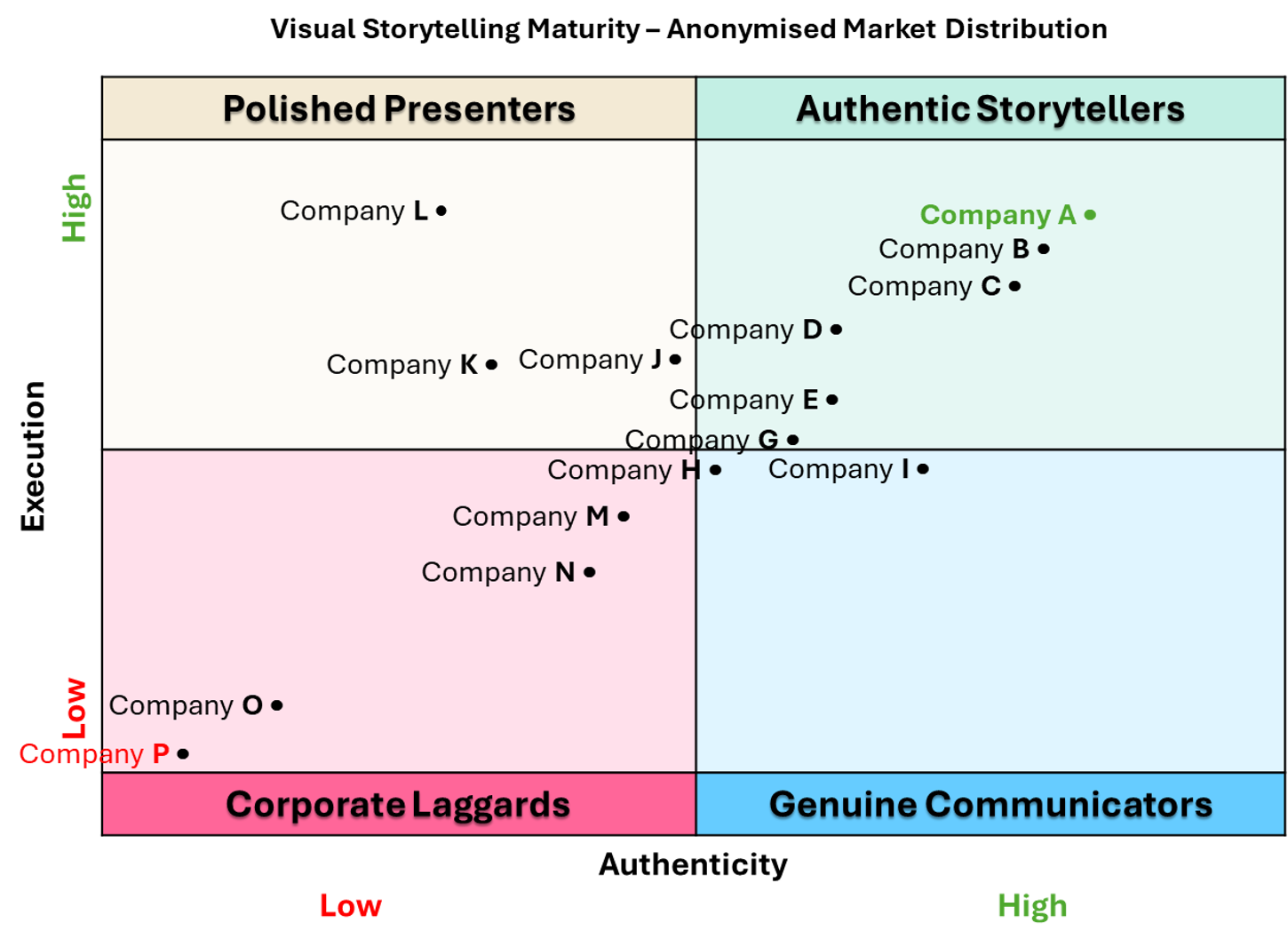
Project Authenticity is a proprietary audit methodology developed through the analysis of sixteen or more major Western Canadian organisations across the energy, mining, infrastructure, and municipal sectors. It scores organisations across six criteria on a 30-point composite scale called the Authenticity Index.
Criterion 1: Authenticity Are the images genuine to your operations, your people, and your locations? Or could they belong to any organisation in any sector? Generic imagery scores low regardless of production quality.
Criterion 2: Indexicality Does the imagery constitute documentary evidence? Indexed photography proves something happened. Stock photography proves nothing. This criterion directly addresses the disclosure integrity question.
Criterion 3: Narrative Coherence Does the imagery support the written claims in your report? Where your text is specific and your imagery is generic, the gap is visible to any informed reader. Narrative coherence measures the alignment between what you say and what you show.
Criterion 4: Action Documentation Does the imagery show work being done, decisions being made, and projects being delivered? Or does it show people posing for the camera? The distinction between documented action and performed action is central to visual credibility.
Criterion 5: Emotional Connection Does the imagery reflect genuine human experience within your organisation? Or does it reproduce the generic emotional register of stock libraries? Authentic emotional content is produced by being present, not by selecting from a catalogue.
Criterion 6: Representation Does the imagery accurately reflect your workforce? Its diversity, its roles, its reality? Or does it present an aspirational version of your organisation that your actual employees would not recognise?
Each criterion is assessed independently. The composite score identifies precisely where the Visual Credibility Gap is widest and where corrective investment has most impact.
What an Audit Finds
Across the organisations analysed through Project Authenticity, several patterns recur with striking consistency.
The eye contact problem. In one audit, an organisation had zero instances of direct eye contact with the camera across their entire annual report. Workers were consistently photographed at an angle, faces partially obscured by branded PPE, creating a systematic psychological barrier between the reader and the workforce. The organisation's written narrative emphasised people-first culture. The imagery communicated the opposite.
The stock-to-original ratio. Many organisations use stock imagery for more than half of their report's visual content without recognising it as a credibility risk. When the ratio of genuine operational evidence to sourced imagery is quantified, the scale of the gap becomes concrete and difficult to dismiss.
The location disconnect. ESG reports frequently feature landscape imagery with no verifiable connection to the organisation's actual operations. A mining company illustrated its environmental stewardship section with a generic forest photograph. Nothing in the image confirmed whose forest it was, where it was located, or what the organisation's relationship to it might be. The imagery did not prove anything.
The labour representation gap. Corporate reports consistently over-represent leadership and under-represent frontline workers. The workforce doing the actual work the report describes is frequently invisible. This creates a representation gap that attentive stakeholders and union representatives increasingly flag.
Why This Is Now a Governance Issue
For most of the history of corporate reporting, visual credibility was treated as a matter of design quality and brand consistency. That era is ending.
CSDS 1 and 2 and IFRS S1 and S2 establish frameworks for sustainability disclosure that emphasise verifiability, comparability, and accountability. They do not address photography directly. But they create an environment in which visual evidence functions differently than it did in purely narrative reports. Claims must be supportable. Disclosures must be defensible. An organisation that asserts robust environmental stewardship and illustrates it with stock photography is creating a gap between claim and evidence that will attract scrutiny.
Greenwashing accusations are increasingly targeted at the gap between what organisations claim and what they can demonstrate. Visual inauthenticity is one of the more visible and easily documented forms of that gap. A competitor, a regulator, a journalist, or an activist organisation with access to your report and a stock library subscription can identify sourced imagery in minutes.
The question is whether your board has quantified this exposure.
What Closing the Gap Requires
The Visual Credibility Gap is not closed by replacing all stock imagery with original photography in a single reporting cycle. It is closed through a structured approach to visual governance that treats photography as an ongoing operational documentation function rather than a one-off creative commission.
In practical terms, this means three things.
First, an audit to establish a baseline. Before making investment decisions, an organisation needs to know precisely where its gap is widest, which criteria score lowest, and which communications are most exposed. The Project Authenticity audit provides this baseline.
Second, a planned photography programme aligned to reporting requirements. The most effective operational photography is captured throughout the year, embedded in project milestones, site visits, and people moments, rather than commissioned in a rush in the weeks before report production begins. Annual reports produced from a year's worth of authentic operational imagery are visually and evidentially stronger than those assembled from a two-day shoot and a stock library.
Third, a shift in how visual commissioning decisions are made. Photography decisions in most organisations sit with communications and design functions. In organisations where visual credibility has been elevated to a governance concern, photography commissioning involves legal, sustainability, and investor relations input. The images selected for inclusion are evaluated for what they prove as much as for how they look.
About the Author
Sean Bell is a Certified Professional Photographer (CPP) and Visual Strategist based in Calgary, Alberta. He is the founder of Project Authenticity, the proprietary framework for auditing visual credibility in corporate and sustainability reporting.
His background is unconventional for the photography industry. He served as a British Army Officer, where operational documentation and ground truth reporting were professional requirements. He then spent years as an EY Partner, where he developed fluency in corporate governance, sustainability disclosure, and the gap between what organisations claim and what they can demonstrate.
Sean Bell Creative Media operates across Western Canada, serving clients in the energy, mining, infrastructure, and professional services sectors. The firm provides visual auditing, strategic operational photography, executive portraiture, and aerial documentation.
To discuss a Project Authenticity audit or request one of the white paper series, contact Sean directly at seanbell@seanbellcreative.com or visit seanbellcreative.com/project-authenticity
Related pages: